

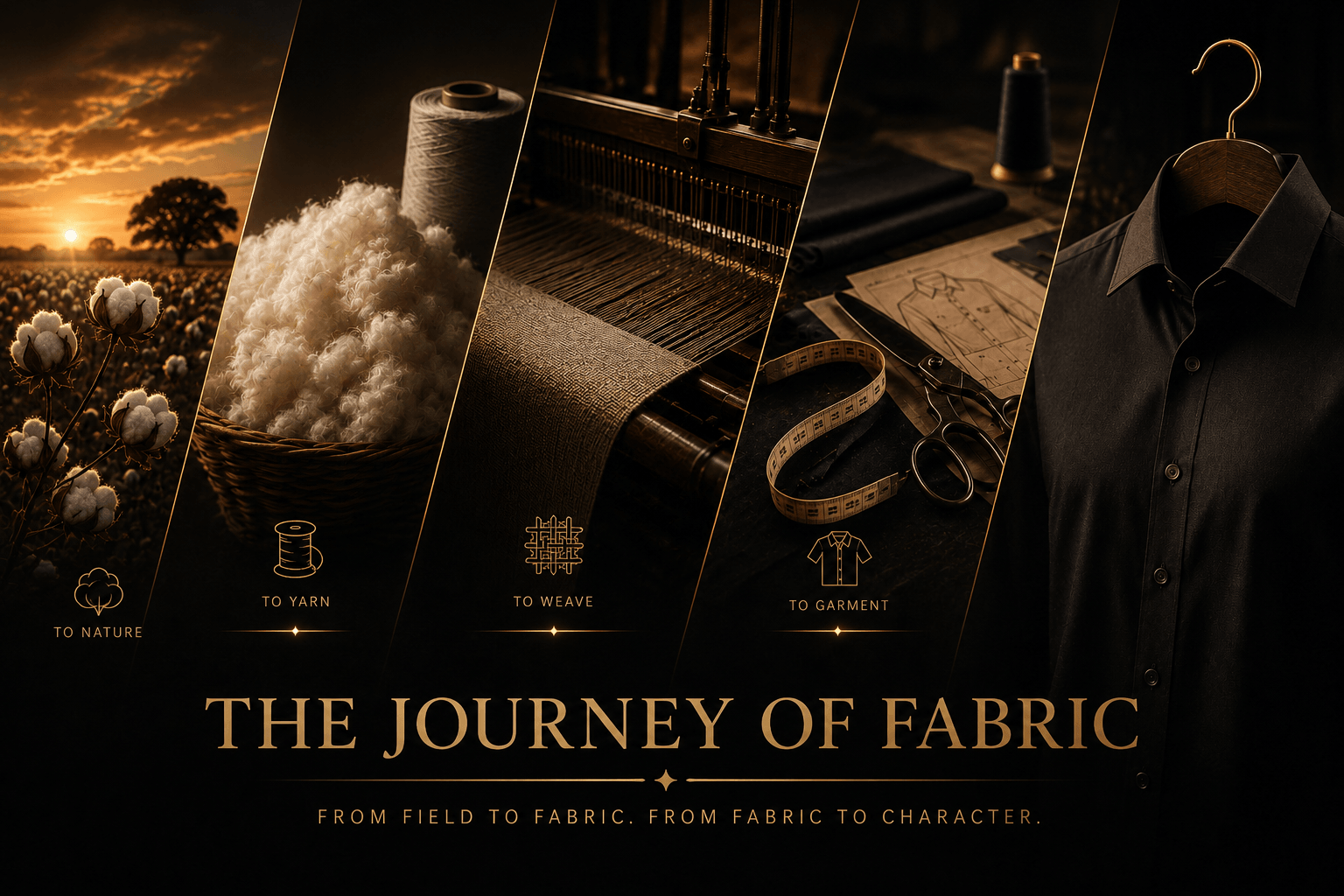
Most men never think about the shirt on their back. They button it, roll the sleeves, walk out the door. It does its job quietly and they move on — which is exactly how good clothing is supposed to feel. But the piece he pulls off the hanger has already lived a long life before it ever reached him, and that life is worth knowing.
It starts in a field
Long before there's a garment, there's a plant or an animal and a season of patience. Cotton begins as a small white burst in a field somewhere warm, picked when it's ready and not a day sooner. Wool comes off a sheep after a full year of growing, sheared in one honest pass. Linen is pulled from flax, a crop that asks for cool weather and doesn't tolerate shortcuts.
None of this happens fast. You can't rush a growing season, and you can't fake a good fibre. The men and women who work these fields judge quality by hand — the length of a cotton staple, the crimp of a fleece, the strength of a flax stem. What they choose here decides everything that comes after.
A cheap fibre will always be a cheap fibre, no matter what's done to it later.
From loose fibre to thread
Raw fibre on its own is useless. It's soft, tangled, going nowhere. The turning point is spinning — twisting those short, weak strands into a continuous thread strong enough to hold a life of wear.
This is where the difference between ordinary and fine really begins. Longer fibres, spun tightly and evenly, make a thread that's smooth, durable and comfortable against the skin. Shorter fibres, rushed through, leave a yarn that pills, weakens and gives out early. The thread is the foundation of the whole garment. Get it wrong and there's no saving it downstream.
The loom does the real work
Then comes the weave — thousands of threads crossing over and under one another on a loom, turning line into cloth. Warp runs the length, weft runs across, and the way they interlace decides how the fabric behaves: how it drapes, how it breathes, whether it holds a crease or falls soft.
- Plain weave — honest and breathable.
- Twill — a diagonal grain that is tougher and hides wear well; think of the quiet rib in good chino cloth.
- Satin — floats the threads to catch light, which is why it feels smooth and looks a little richer.
This is where a fabric gets its character. Two shirts can start from the same cotton and end up completely different, purely because of how the cloth was built.
The details you only notice up close
Woven cloth still isn't finished. It gets washed, brushed, sometimes rested and pressed, so it settles into the hand feel you'll actually live with. This finishing stage is where the small, invisible decisions happen — the ones that separate a garment you tolerate from one you reach for again and again.
It's the softness that doesn't wash out after a month. The colour that stays honest instead of fading to grey. The weight that feels substantial without being heavy. Nobody points at these things in a compliment, but they're the reason a good piece feels good every single time you put it on.
And finally, the cut
Only now does fabric become clothing. Patterns are laid, cloth is cut, seams are sewn, and a flat length of material takes the shape of a man. A great fabric can still be ruined by a lazy cut, and a sharp cut can't rescue poor cloth — the two have to earn each other. When they do, you get something that fits, moves and holds up. Something built to be worn, not just bought.
Why any of this matters
Here's the thing worth sitting with: by the time a shirt reaches a man's hands, it has passed through a field, a spinner, a loom, a finisher and a cutter — dozens of choices made by people who cared about getting it right, none of whom he'll ever meet.
That's not so different from the man himself. Real quality is built quietly, in stages, over time — through work that no one applauds and details no one sees. A garment made this way doesn't announce itself. It just holds up, day after day, exactly like the men we make it for.
That's the journey inside every piece we build. You don't have to see it to feel it. But once you know it's there, you never look at a shirt the same way again.

